
medicalskin-cancer
The Moles Worth Seeing a Dermatologist About
By Dr. Qusai Shakhatreh ·
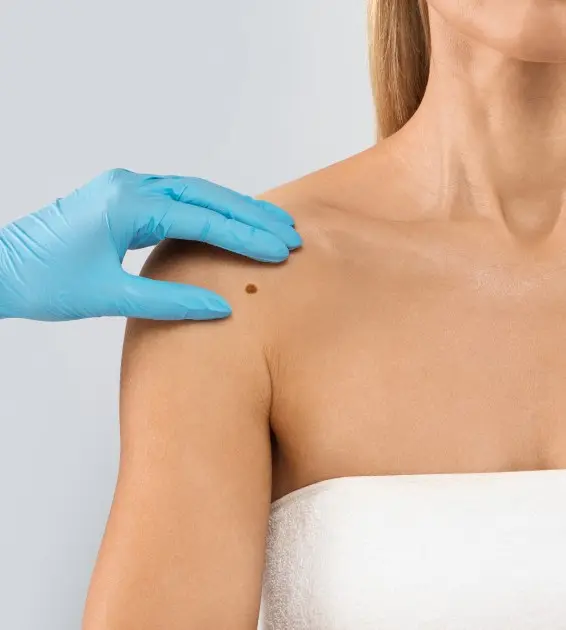
Most moles are unremarkable. The ones that are not usually announce themselves through change rather than through size, and the change is easy to miss on skin that is already marked.
The rule dermatologists ask patients to watch for is the ABCDE: an Asymmetry, where one half does not match the other; a Border that is irregular or notched; a Colour that is uneven or has more than one shade; a Diameter larger than six millimetres, though a changing smaller lesion still matters; and an Evolution, any change in size, shape, colour, or how it feels.
Two things matter as much as the list. First, new spots appearing after adulthood are worth checking. Second, 'I would have noticed if it had changed' is not a reliable test — people do not routinely examine the same patch of skin, and a lesion on the back or the scalp may go years between being seen.
A dermatologist uses dermoscopy, which is a handheld magnifier that makes the subsurface pattern visible. It is quick, it does not hurt, and it finds changes that are not obvious to the eye. If a mole is flagged, photographing it so the next visit can be compared against is the most useful thing to do in between.
A mole that is bleeding without being scratched, or that has not healed over several weeks, should be seen without waiting for any of the above.