
Nova Derma | Amman, Jordan
Alopecia Areata Treatment in Amman
Dermatologist-Led Diagnosis and Treatment for Patchy Autoimmune Hair Loss
Alopecia areata is not contagious — and it is not simply 'hair loss from stress.'
Alopecia areata is an autoimmune hair-loss condition that commonly causes sudden, smooth, round or oval patches of hair loss on the scalp, beard, eyebrows or other areas.
It is a non-scarring form of hair loss, which means the hair follicles are not permanently destroyed and regrowth is possible. However, the course is unpredictable and new patches can appear even after complete regrowth.
We Assess
- One or more sudden smooth patches of hair loss
- Scalp alopecia areata
- Beard alopecia
- Eyebrow or eyelash involvement
- Recurrent patches after previous regrowth
- More extensive or rapidly progressing alopecia
- Nail changes occurring with alopecia areata
- Patchy hair loss when the diagnosis is uncertain
Patchy hair loss has several possible causes, and this is the consultation where they are told apart.
Signs that may support the diagnosis
What Does Alopecia Areata Look Like?
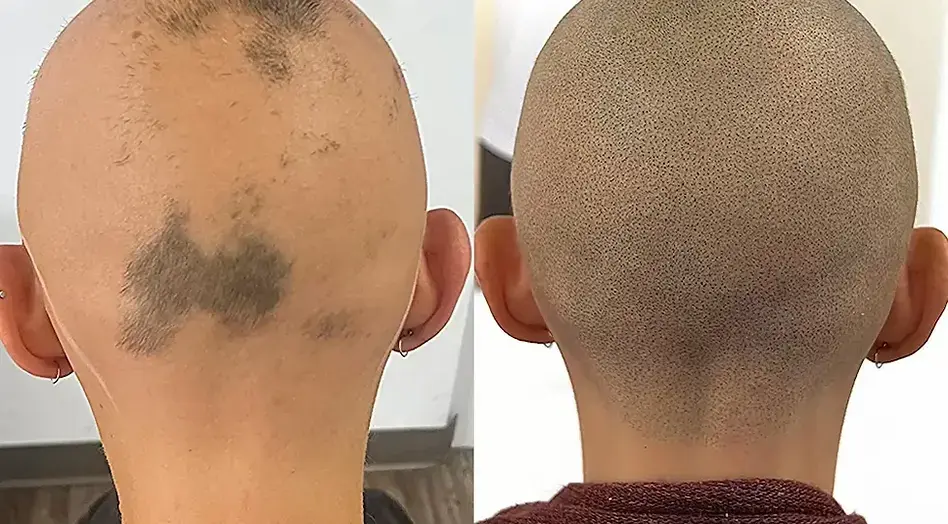
Typical alopecia areata produces smooth areas of hair loss without the scarring seen in permanent follicular disorders. Some patients have one small patch, while others develop several patches or more extensive hair loss.
Smooth round or oval bald patches
Short broken or 'exclamation-mark' hairs near the edge of an active patch
Yellow dots, black dots or other characteristic findings on dermoscopy / trichoscopy
Eyebrow, eyelash or beard involvement
Small pits or other nail changes in some patients
Scaling, marked redness, pustules, significant tenderness or obvious scarring are not typical of straightforward alopecia areata and may suggest another scalp condition that needs a different approach.
How We Diagnose Alopecia Areata
Clinical examination & dermoscopy. A dermatologist can often diagnose alopecia areata from the pattern of hair loss and examination of the scalp, hair and nails. Dermoscopy / trichoscopy can provide additional clues and help assess disease activity.
Are blood tests always needed? No. Alopecia areata is usually a clinical diagnosis, and routine broad laboratory testing is not required for every patient.
Selected external laboratory tests may be recommended when the history or examination raises concern about thyroid disease, iron or nutritional status, another autoimmune condition or a separate cause of hair loss.
When is a scalp biopsy needed? A biopsy is not routine. It may be considered if the diagnosis remains uncertain or another inflammatory or scarring hair-loss disorder needs to be excluded. When clinically indicated, a scalp biopsy can be performed at Nova Derma and the specimen sent to an external pathology laboratory.
Laboratory testing is arranged externally
Treatment Options for Alopecia Areata
Treatment depends on the number and location of patches, disease activity, age, duration, previous episodes and how much hair has been lost. Not every patient needs immediate treatment.
Intralesional Corticosteroid Injections
For suitable localized patches, small amounts of corticosteroid medication can be injected directly into the affected areas to reduce immune-mediated inflammation and encourage regrowth.
Treatment is usually performed as a series rather than a single injection session, with progress reviewed between visits. Temporary skin thinning or a small indentation can occur at injection sites.
Topical Corticosteroid Treatment
Prescription topical corticosteroids may be used for selected patients, particularly when injections are not appropriate or practical. The product and duration are chosen according to age, location and disease extent.
Minoxidil as Supportive Treatment
Minoxidil may sometimes be added to support or maintain regrowth, but it does not treat the autoimmune cause of alopecia areata and is not usually the primary treatment on its own.
308 nm Excimer Treatment
Targeted 308 nm excimer therapy may be considered for selected localized alopecia areata patches, usually as an adjunct to condition-specific medical treatment.
The evidence for excimer in alopecia areata is smaller and less predictable than for established local corticosteroid treatment, so it should be offered selectively rather than presented as the default treatment.
More Extensive or Rapidly Progressive Alopecia
When hair loss is extensive, rapidly progressing, affects a large proportion of the scalp, or involves eyebrows and eyelashes significantly, a broader medical treatment strategy may be needed. Systemic or targeted immune-modulating treatments may be considered in appropriate patients after assessment, screening and discussion of risks and benefits.
Extensive disease should not simply be treated by repeating local procedures on every patch.
Is Alopecia Areata Caused by Stress?
Alopecia areata is an autoimmune condition. Emotional or physical stress may trigger or aggravate an episode in some people, but many patients have no obvious trigger.
Stress should therefore not be presented as the sole cause, and treating stress alone is not a substitute for diagnosing and treating active alopecia areata.
Will the Hair Grow Back?
Regrowth is possible, especially in limited patchy disease, and some patients regrow hair even without treatment. However, it is not possible to predict the timing or amount of regrowth for an individual patient.
New hair may initially appear fine or lighter in color before becoming thicker and regaining its usual color.
Alopecia areata can relapse. A patch that has completely regrown does not guarantee that another patch will never appear.
What Is Not a Primary Alopecia Areata Treatment?
PRP, CosmeRNA®, Regenera Activa®, hair fillers and exosome-based scalp treatments are not positioned at Nova Derma as primary treatments for alopecia areata.
These options belong mainly to other hair-loss pathways. Alopecia areata requires condition-specific anti-inflammatory or immune-directed management.
Alopecia Areata FAQ
Can the hair grow back without treatment?
Yes. Spontaneous regrowth can occur, particularly when only a few patches are affected, but the course cannot be predicted.
What is the usual treatment for a few patches?
In suitable patients, intralesional corticosteroid injections are a commonly used and effective option. Topical corticosteroids may also be used, especially when injections are not appropriate.
Can minoxidil treat alopecia areata?
Minoxidil may support or help maintain regrowth, but it does not treat the autoimmune driver and is not generally used as the main treatment by itself.
Can 308 nm excimer help?
It may help selected localized cases and can be used as an adjunct. Response is variable, and it is not automatically the first treatment for every patch.
Do I need blood tests?
Not routinely. Testing is selected according to the history and examination.
Can alopecia areata affect the beard or eyebrows?
Yes. It can involve the beard, eyebrows, eyelashes and other body hair as well as the scalp.
Can it come back after regrowth?
Yes. Alopecia areata can relapse, and new patches may appear after earlier patches have completely regrown.
Concerned About Sudden or Patchy Hair Loss?
Patchy hair loss can have several causes, including alopecia areata, fungal scalp infection, hair pulling, inflammatory scalp disease and other forms of alopecia. Confirming the diagnosis is the first step.
At Nova Derma, alopecia areata treatment may include intralesional corticosteroid injections, topical medical treatment, supportive minoxidil and selected 308 nm excimer therapy, with escalation or referral when more extensive disease requires a broader treatment strategy.
Nova Derma · Amman, Jordan